.png?width=90&height=90&name=my-notion-face-portrait%20(2).png "My notion face (Sondos Yasser)")
ChatGPT ads: what marketers need to know in 2026
ChatGPT ads are sponsored cards that OpenAI began showing inside ChatGPT answers in February 2026. One card, clearly labeled, slotted underneath a normal conversational response, shown only to logged in Free and Go tier users.
In short: ChatGPT ads let you reach people in the middle of an actual buying conversation rather than matching a keyword or a browsing history. Self serve access opened to US businesses in May 2026 with no minimum spend, and by late September 2026 availability had expanded to more than 60 countries. This guide covers why to use them, where they work, what changed recently, what they cost, how to write ones that perform, and where to see real examples already running.
In this guide
Why to use it
A few reasons marketers are testing budgets here already:
- Genuine buying intent, not just keywords. Someone asking ChatGPT how to protect their family from identity theft is further along than someone typing a search term. Ads are matched to the conversation itself, not a guess based on past searches.
- Early and still uncrowded. Sponsored answers only started appearing in June 2026. Most categories are still thin, which means less competition than an established channel right now.
- No minimum spend anymore. Early access ran through managed partners with large minimums. Since self serve opened, you can test with a small budget instead of committing a large sum upfront.
- A large and growing audience. ChatGPT reports hundreds of millions of weekly active users, and that number is still climbing.
The honest caveat: this channel is young. Reporting from September 2026 found real advertisers with results all over the map, cost per click under $3 for some, $10 to $13 for others, with no standardized benchmarks yet across industries. Treat early budgets here as a genuine test, not a guaranteed win.
Where is it available
ChatGPT ads launched in the United States in February 2026, shown only to Free and Go tier users. Paid subscribers on Plus, Pro, Team, Business, and Enterprise plans do not see ads, and neither do users under 18.
Self serve access for advertisers opened to US businesses in May 2026. From there it expanded steadily: Europe, India, and the Middle East and North Africa gained self serve access around the end of August 2026, bringing the total to 52 countries by early September. Southeast Asia and Taiwan were added on September 23, 2026, pushing availability past 60 countries.
Availability depends on both your business's market and the audience you are targeting, and this list keeps growing. Check the eligibility section inside Ads Manager at ads.openai.com for the current status before building a campaign.
Recent updates
This moves quickly, often week to week. As of late September 2026, the biggest recent changes are:
- Product feeds are now required for shopping placements. As of September 4, 2026, only ecommerce brands with a connected product feed appear in ChatGPT shopping results. Without one, your products will not show up there at all.
- A new Ads Manager plugin. OpenAI released a conversational plugin that lets you turn a website or a creative brief into launch ready ads, generate variants, and troubleshoot delivery, directly inside ChatGPT instead of a separate dashboard.
- Sponsored Agents and a native Shopify integration. Launched September 16, 2026 for US merchants, with international rollout following on September 23.
- A one billion dollar annualized revenue run rate. OpenAI reported hitting this in under 200 days from launch, alongside the expansion into Europe, India, and the Middle East and North Africa.
Because this platform is still this new, treat anything you read, including this guide, as a snapshot. Check OpenAI's own announcements for whatever has shipped since.
How much do ChatGPT ads cost
At launch, early access ran through managed sales with a reported cost around sixty dollars per thousand impressions and a two hundred thousand dollar minimum. That minimum is gone now that self serve is open, and reported rates have come down from there.
Real advertisers surveyed in September 2026 reported cost per click anywhere from under three dollars to ten or thirteen dollars, depending on category, format, and how new the account is. OpenAI has not published one universal public rate card, so pricing varies by market, format, and account.
The practical takeaway: because there is no minimum spend anymore, you can test with a genuinely small budget and see your own numbers rather than relying on anyone else's reported range, including this one.
Best practices
ChatGPT does not match ads to a keyword. It considers the conversation itself, so writing for it takes a different approach than a search or social ad. OpenAI's own guidance for advertisers comes down to a handful of principles:
- Build for coverage, not one message. A diverse set of title and copy variations for the same offering helps the system find more conversations where your ad genuinely fits.
- Keep each variation genuinely distinct. Give each one a different angle rather than rewording the same line.
- Write benefit focused copy. Explain the practical value of what you offer, who it is for, and when it helps, instead of a catchy line or a generic call to action.
- Focus on usefulness. An ad should feel helpful to what the person is actually trying to do in that conversation, not like an interruption.
- Represent your offering accurately. Misleading or inconsistent ads get rejected under OpenAI's ad policies, and honest messaging performs better anyway.
If you sell products, connect your product feed before writing a single ad. Shopping placements will not show your products otherwise, no matter how good the copy is.
See real examples in the ChatGPT Ad Library
Before writing your own ads, it helps enormously to see what is already running. The ChatGPT Ad Library is a public database that captures sponsored cards showing up inside ChatGPT by probing it with realistic prompts, then recording the creative, the advertiser, and the exact prompt that triggered it.
You can browse by industry, from enterprise software to real estate to travel, and see which brands are active, what their creative actually says, and which prompt groups in your category still have little or no advertising pressure. The site reports tens of thousands of captured ad creatives across thousands of advertisers, though these figures reflect its own captured sample rather than OpenAI's complete advertiser data.
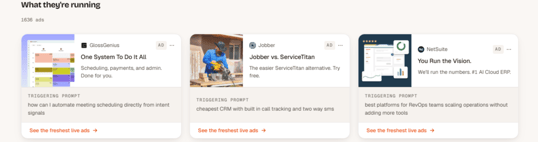
Used well, it turns guessing into research: check your category before you write a single headline, see how competitors are already positioning themselves, and look for an angle or a prompt group nobody has claimed yet.
Getting started
A simple sequence to actually launch a first test:
- Check your eligibility and current country availability inside Ads Manager at ads.openai.com.
- If you sell products, connect your product feed first, since shopping placements require one.
- Browse the ChatGPT Ad Library for your category to see what is already working before you write anything.
- Write several genuinely distinct ad variations following the best practices above, not one message repeated five ways.
- Start with a small test budget. There is no minimum spend required anymore, so there is no reason to commit heavily before you have your own numbers.
- Set up conversion tracking so you can actually measure what happened, not just impressions.
If you already have a funnel mapped out, match each ad variation to the stage it is meant to support rather than sending every click to the same generic page. I cover that mapping process in why planning a conversion funnel is important.
Things to watch out for
A few realities worth knowing before you budget seriously for this channel:
- Your audience is Free and Go tier users only. Paid subscribers never see ads, so your reachable audience is a portion of ChatGPT's total user base, not all of it.
- No standardized benchmarks exist yet. Results genuinely vary by industry and account right now, so treat any number you read, including the ranges in this guide, as a starting point rather than an expectation.
- Ads personalization is opt in for users. Targeting depth depends on how many users in your audience have it enabled.
- Sensitive categories are restricted. Health, mental health, and political content all face tighter policy limits, so check OpenAI's ad policies before building a campaign in a sensitive niche.
Should you test it
ChatGPT ads are new enough that nobody has this fully figured out, including the brands already spending money there. That is exactly why a small, honest test is worth running now rather than waiting for a channel that has already gotten crowded and expensive. Check the ad library for your category, connect your product feed if you sell products, write a genuinely diverse set of ads, and start small.
For more on how AI is reshaping the rest of your marketing beyond this one channel, see how AI is changing digital marketing in 2026. If you want a single place to track which AI tool to reach for at each step of your workflow, that is exactly what my AI Marketing Hub template is built for.
For more breakdowns like this as they develop, subscribe to my Simplified Marketing newsletter.
Frequently asked questions
What are ChatGPT ads?
ChatGPT ads are sponsored cards that appear below a normal ChatGPT answer, clearly labeled as advertising. They do not change the answer itself and are shown only to logged in Free and Go tier users.
When did ChatGPT ads launch?
ChatGPT ads launched in the United States in February 2026. Self serve access for advertisers opened in May 2026, and availability has since expanded to more than 60 countries as of late September 2026.
How much do ChatGPT ads cost?
There is no universal published rate card and no minimum spend since self serve opened. Reported cost per click has ranged from under three dollars to ten or thirteen dollars depending on category and account, so current numbers should be checked directly in Ads Manager.
Can I see what ads are already running on ChatGPT?
Yes. The ChatGPT Ad Library is a public database of sponsored cards captured inside ChatGPT, searchable by industry, advertiser, and the prompt that triggered each ad, which is useful for research before launching your own campaign.
Do ChatGPT ads work for small businesses?
They are more accessible now than at launch. Early access required a large minimum spend through managed partners, but self serve access removed that minimum, so a small business can test with a modest budget.
.png)
-1.png)